Nut: Transfers concentrated stress from surrounding rock to the plate.
Arch Washer (Arch Plate): Bears higher stress from surrounding rock.
Grout Stop Plug: Maintains grouting pressure to fully fill voids in the rock mass.
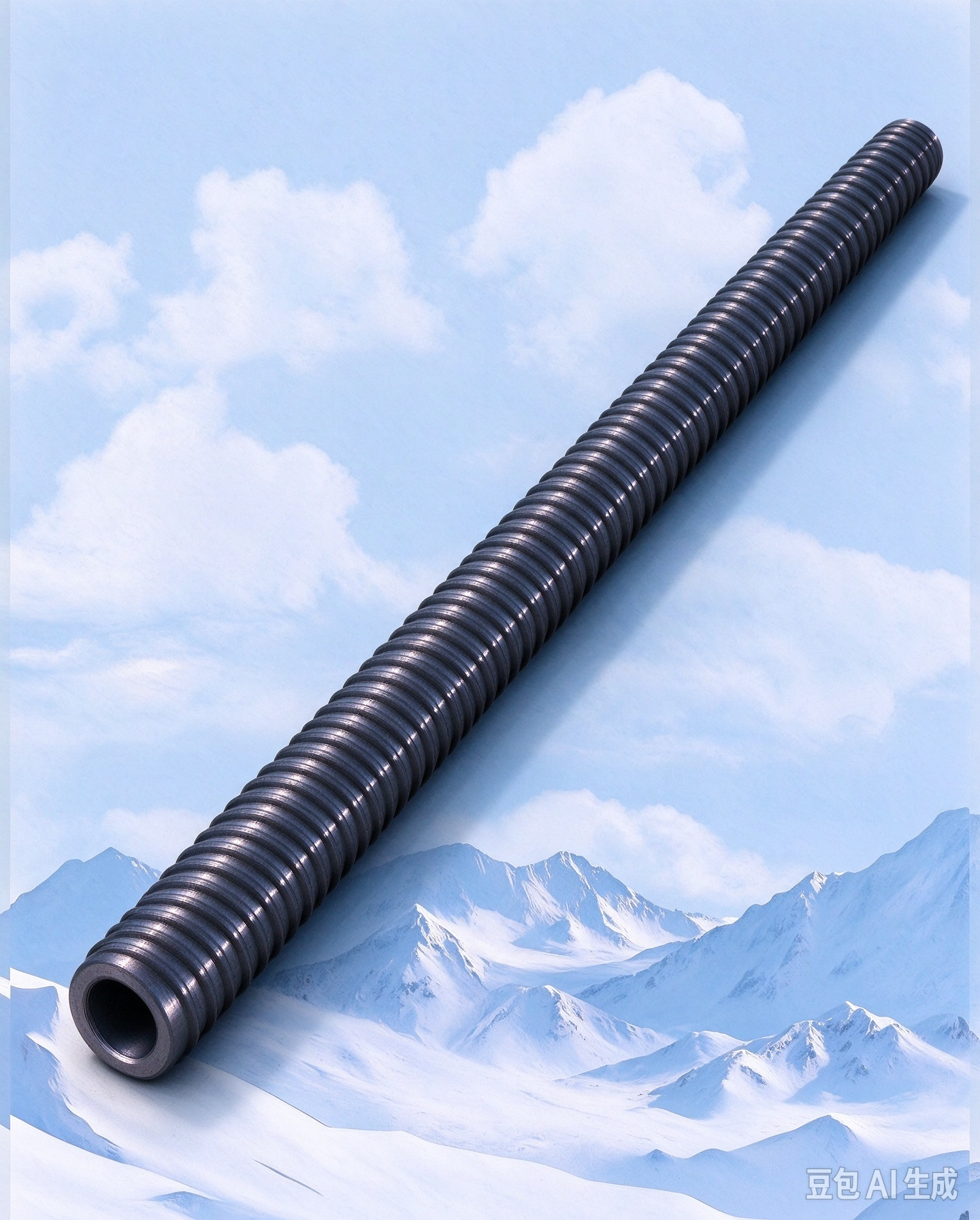
Anchor Bar: Full-length continuous thread in international standard profile. It allows fitting of drill bits and coupling sleeves, tightening of nuts, and can be cut or extended as required.
Pipe Canopy Coupling Sleeve: Enables extension of the pipe canopy during drilling to reach the designed depth.
Carbide Drill Bit: Offers strong penetration capacity, allowing the pipe canopy to drill through various rock formations.
3. Features of Self-drilling Pipe CanopyThe pipe canopy can be equipped with high-penetration carbide drill bits. Driven by a rock drill, it can easily penetrate all types of rock.
It features continuous international standard profile threads. It can act as a drill rod together with the bit to form anchor boreholes.
The pipe canopy body used as the drill rod does not need to be pulled out. Its hollow bore serves as a grouting channel for grouting from inside out.
The grout stop plug maintains high grouting pressure to fully fill voids and consolidate broken rock mass. The high-strength washer and nut evenly transfer deep surrounding rock stress to the tunnel wall, achieving mutual support between the rock mass and the bolt.
High-strength coupling sleeves allow the self-drilling pipe canopy to be extended while drilling. It is suitable for narrow working spaces and fulfills the design requirement of long anchor reinforcement for surrounding rock.
Thanks to its three-in-one function, it can form anchor holes and guarantee anchoring and grouting results under various rock conditions without special procedures such as casing protection or pre-grouting.
Note: The key distinction of self-drilling pipe canopy lies in the quality of the drill bit. Custom lengths are available upon request.4. Overview of Construction Method for Self-drilling Pipe CanopyPipe canopy advance support is a new tunneling technology developed in recent years for excavation in weak surrounding rock. As an auxiliary tunneling construction method, the pipe canopy method plays a vital role when passing through fracture zones, loose zones, weak strata, water inrush and quicksand layers during soft rock tunnel construction.The pipe canopy adopts steel pipes as longitudinal supports and steel arches as transverse annular supports to form an integrated longitudinal and transverse support system. It functions as a beam along the tunnel axis and delivers arching support effect in the cross-section. Thanks to its high rigidity, it effectively restrains surrounding rock deformation and bears the initial rock pressure in advance.At present, pipe canopy support is widely used in tunnel engineering, especially at tunnel portals where the rock mass is mostly weathered, fractured and of poor quality. Pipe canopy advance support is commonly adopted to guarantee safe tunnel breakthrough.For loose and fractured weak surrounding rock, conventional pipe canopy construction struggles with borehole forming and casing advancement, leading to uncontrollable construction quality. In such cases, casing following drills are applied for pipe canopy installation in weak ground.There are two main borehole forming methods for pipe canopy construction:Pilot hole & pipe jacking method: For formations with good borehole stability, drill the hole first and insert the pipe afterwards. After borehole inspection and acceptance, connect the pipe canopy sections and rotate & jack them into the borehole by the drill rig.
Casing-following drilling method: For complex geological conditions including sand and gravel, rock piles, boulders or fracture zones prone to borehole collapse, the casing and drill rod are advanced together. Once drilling is completed, the drill rod is withdrawn, the pipe canopy is jacked in, and the outer casing is pulled out.